> For the complete documentation index, see [llms.txt](https://annamarieswan.gitbook.io/ecological-organisations/llms.txt). Markdown versions of documentation pages are available by appending `.md` to page URLs; this page is available as [Markdown](https://annamarieswan.gitbook.io/ecological-organisations/ecological-organisations-a-design-lens/introducing-ecological-organisations.md).
# Introducing Ecological Organisations
Welcome to the online homebase for all things ecological organisations.
**‘Ecological organisations’ is a reimagined story** **of organisations as rich living systems formed of flows of relationship, care, information, and intelligence that are utterly entangled within wider ecosystems and social systems**: from place to neighbourhoods, cultural stories and histories, languages and worldviews, the more-than-human to planet Earth (and much more).
**Ecological Organisations: A Design Lens is shared freely so that any organisational founders, stewards, and guides that want to support organisations to move into becoming more ecological have a starting point, if they would like one.**
{% hint style="info" %}
This free site houses all of the ecological organisations information and links in one place, including the latest version of Ecological Organisations: A Design Lens in various formats: PDF, poster, black and white, and as a text-only document.
{% endhint %}
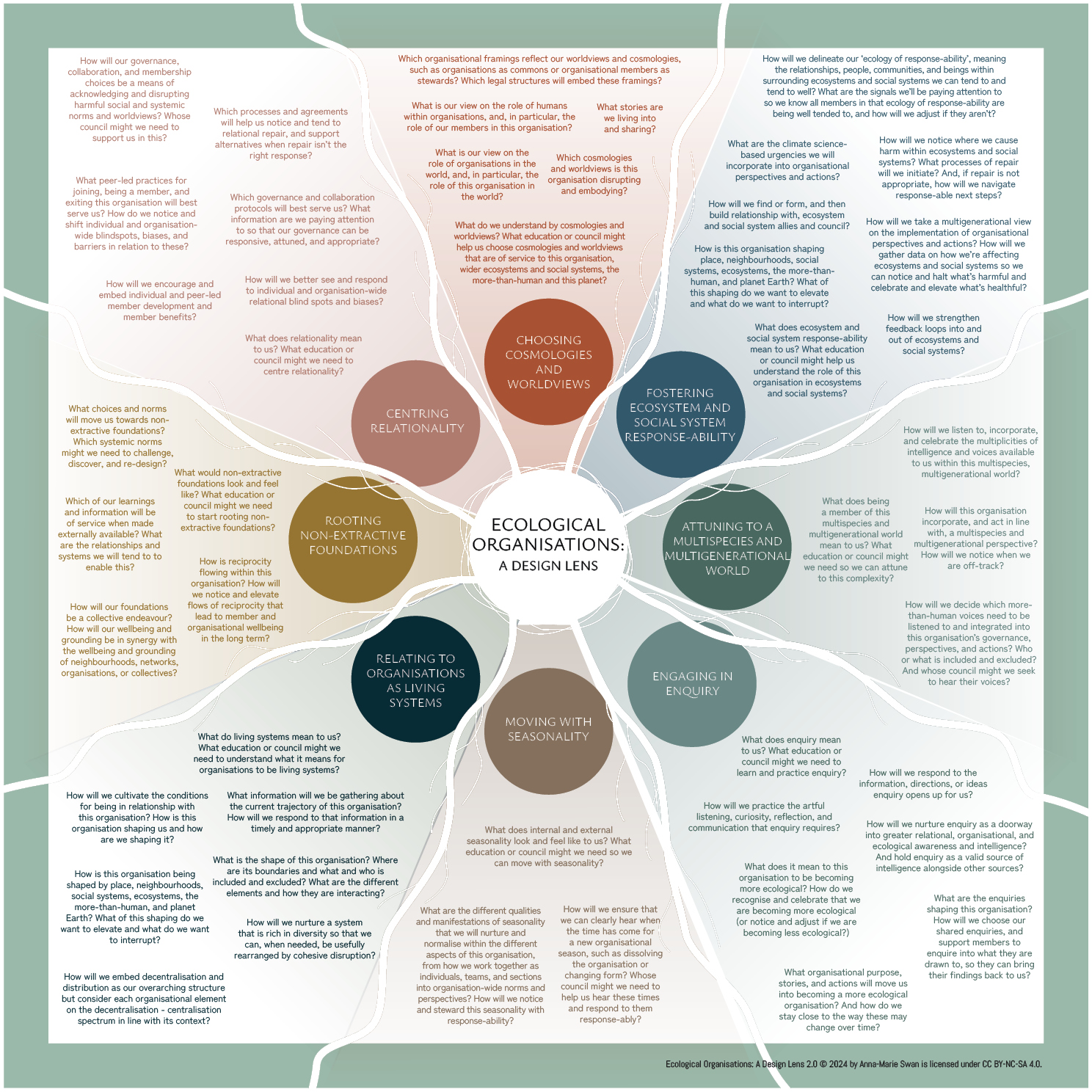
*The below image is the ecological organisations design lens, with eight main areas of focus and multiple questions to help explore each area.*
{% hint style="success" %}
The design lens, and the underlying story of ecological organisations, is rooted in the following premises and invitations:
1\. Organisations are innately **ecological in nature;** and, the way that current systems are arranged mean that very few organisations are able to be **ecological in practise.** However, when we start to embody organisations as innately ecological, **we are now travelling towards organisations being ecological in practise**.
2\. Since organisations are living systems (i.e. ongoing, complex rearrangements of relationships, processes, outcomes, and actions), being ecological as innate nature and practise is **an ongoing unfolding with no arrival point**.
3\. Truly ecological organisations are, therefore, **the work of decades, if not generations,** and, **this knowing holds the invitation to** **start the work now**.
{% endhint %}
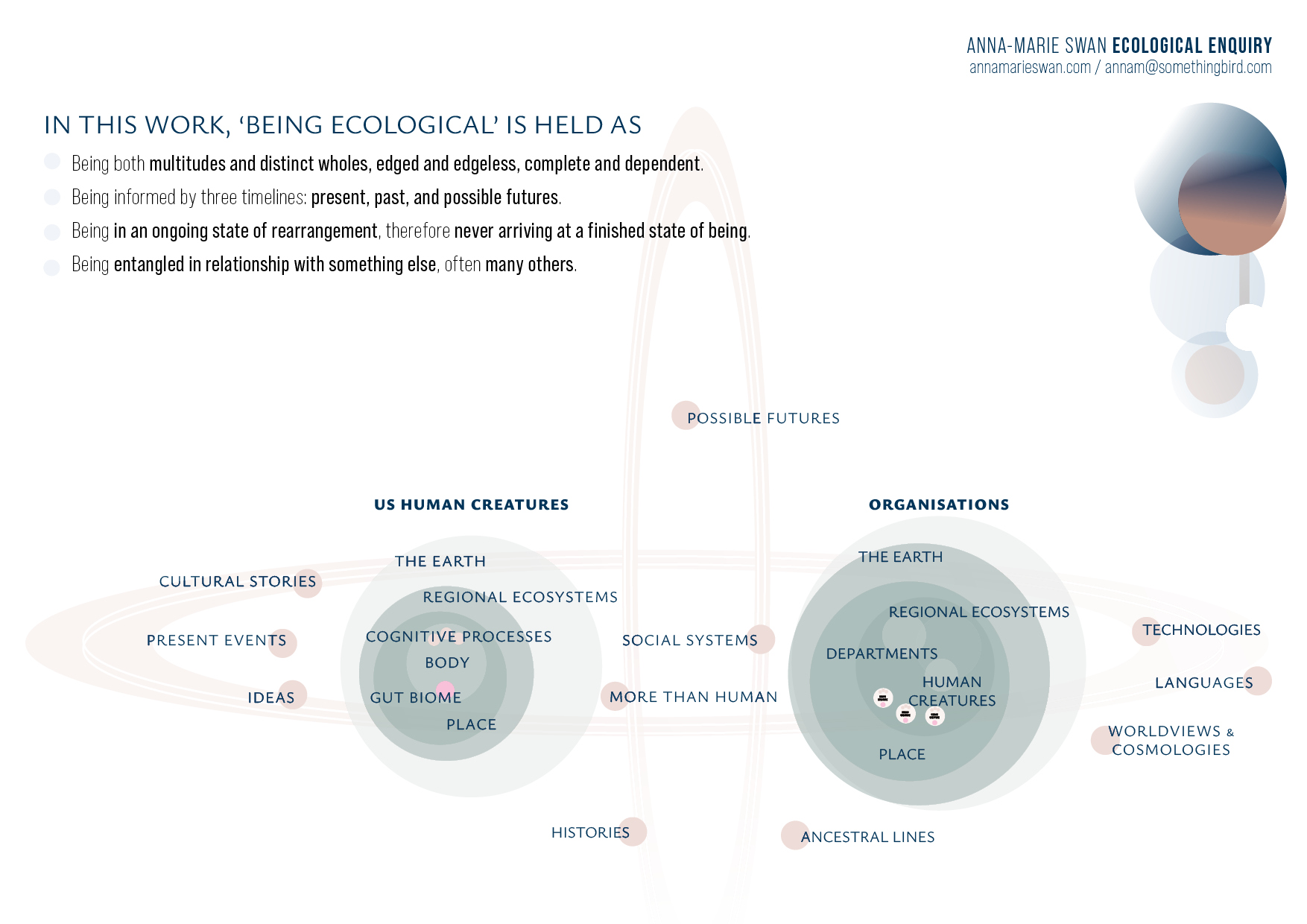
*The below image is a slide showing how 'being ecological' is held in this work, along with a visual image of the ecological complexity that human creatures and organisations navigate.*
{% hint style="success" %}
There are many different lens, framings, and routes into ecologicalness and being a multispecies, multiculturally, multigenerationally-aware organisation that is responsive to the members and beings in the ecosystems and social systems it is entangled with. This work is not intended to be read as the only or the right framing, language, or lens, but one possible lens born of the author's stories, experience, language, perspective, and cosmologies.
The colonial story/worldview so many of us human creatures are unintentionally immersed within values **mind intelligence over the intelligence of feet, heart, hands, and mind** (i.e. the embodied intelligence we access in relationship with each other, the more-than-human, the land beneath our feet, the soil between our fingers, and **new intelligence discovered by a revered individual over recognising ancient, communal intelligences that are simply reimagined by new voices**.
I hope that this work is recognised as being neither new nor an individual holding.
{% endhint %}